Our Arucaunas have started laying! Their eggs are usually pale blue or green. Yesterday, we got our first. We thought maybe they had started but were pale pink, which isn't much different than our brown eggs. When my daughter found it, she ran inside to show everybody.
This egg was one of 19 we yesterday. It's been almost a month of getting 1-2 dozen eggs a day. You'd think we'd be overrun with eggs, but not so. The kids are loving scrambled eggs every morning, hard boiled eggs for lunch, custard, pudding, and lots of baking. Sooner or later we'll get tired of so many eggs, but it hasn't happened yet.
Pepper got some unscheduled time with his mama yesterday. When we went out for evening milking, he was laying down in Christina's area. We must have left the gate unlatched and he got it opened. Our milk was almost a gallon less than normal so he had taken full advantage of the time together.
Seed saving is new to me, but I'm slowly getting the hang of it. I started with the easy ones like lettuce and marigold and grain corn. This year I added pumpkin to my repertoire. We just scooped the seeds out and let them dry. I had put these in the other room a month ago and now they are nice and dry.
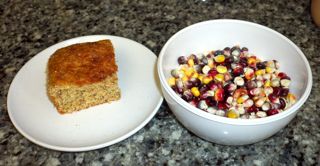
I don't know what it's called when you pop the kernals off corn cobs, but we're doing a lot of it. We finished the Anastasi corn. It looks so beautiful in this jar and tastes even better in corn bread.
I sort of miss being outside, but I am enjoying all this inside work. Sitting in a comfy chair with the fire blazing pulling corn kernals off dry cobs is pretty pleasant.
We are a Catholic family of seven in Boise, Idaho raising our food on one-and-a-half acres, homeschooling, and looking for God in it all.
Showing posts with label corn. Show all posts
Thursday, December 15, 2011
Monday, September 19, 2011
Failure
Remember when I enthusiastically wrote about canning cream and pudding for our trip? That didn't work out. I'd noticed that they were separating, and then I moved the jars and found the lids unsealed. Something had been growing in there. When we poured them out they smelled BAD. The whole house stunk.
Canning failures are a big deal. The stuff in those jars was probably deadly poisonous. I should have looked it up before doing canning experiments. Lesson learned.
Our sweet corn was a complete bust. We only planted one variety and the whole crop failed. This was an experiment with the "three sisters:" corn, beans, and squash. The beans and squash seem to be doing well, but they're all flopped on the ground and the corn didn't even make it three feet tall.
The short plants set some corn cobs, they're not enough to bother with.
This is soil that really needed fertilizer and the corn showed it. I've read about the problem of monoculture at the large industrial scale (only growing one variety), and here we've had an example on the small scale. It will be a year without sweet corn.
Like all failures, these are better thought of as God's teaching moments. Our job is to learn.
Canning failures are a big deal. The stuff in those jars was probably deadly poisonous. I should have looked it up before doing canning experiments. Lesson learned.
Our sweet corn was a complete bust. We only planted one variety and the whole crop failed. This was an experiment with the "three sisters:" corn, beans, and squash. The beans and squash seem to be doing well, but they're all flopped on the ground and the corn didn't even make it three feet tall.
The short plants set some corn cobs, they're not enough to bother with.
This is soil that really needed fertilizer and the corn showed it. I've read about the problem of monoculture at the large industrial scale (only growing one variety), and here we've had an example on the small scale. It will be a year without sweet corn.
Like all failures, these are better thought of as God's teaching moments. Our job is to learn.
Friday, December 17, 2010
Dang Mice
Our grain corn was in the garage in boxes with air holes. Apparently they were also mice holes. My husband knocked the stack of boxes and saw a little mouse face stick out. When we investigated, we discovered a mouse haven in the lower boxes — full of corn power and mouse droppings. The upper boxes were cleaner, but still contained evidence of mouse presence. The whole batch got thrown to the chickens. Dang.
You had to know it would happen sooner or later, losing food to little rodents. I'm trying to be grateful that they weren't in the house — because that's creepy — but I'm feeling pretty snarly about losing all that corn. We still have some that we already cleaned off the cob, so it's not a complete loss.
It's the middle of December and we are finally getting to the leaves. In our defense, the first frost was really late, into November, and the first heavy snow was less than two weeks later. The kids begs us to leave them so they can play, and we're pretty agreeable to not working. Another big snow storm is predicted, but we got some up.
The Christmas story has taken on a new depth for us as we enter our first Christmas with a barn and manger. It's a warm place, milking with only a jacket in 20F weather is fine, but not very clean. Every manger scene I've seen has clean yellow bedding, but in real life, fresh straw quickly becomes pee-soaked and smeared with cow pies. What a place to sleep, forget about birthing. But the animals are gentle and sensitive. Do you think the cow moo gently for Mary as she was in labor? Did the calf give little nudges that feel like loves? Did Joseph get strength and comfort from the animals as he helped Mary?
You had to know it would happen sooner or later, losing food to little rodents. I'm trying to be grateful that they weren't in the house — because that's creepy — but I'm feeling pretty snarly about losing all that corn. We still have some that we already cleaned off the cob, so it's not a complete loss.
It's the middle of December and we are finally getting to the leaves. In our defense, the first frost was really late, into November, and the first heavy snow was less than two weeks later. The kids begs us to leave them so they can play, and we're pretty agreeable to not working. Another big snow storm is predicted, but we got some up.
The Christmas story has taken on a new depth for us as we enter our first Christmas with a barn and manger. It's a warm place, milking with only a jacket in 20F weather is fine, but not very clean. Every manger scene I've seen has clean yellow bedding, but in real life, fresh straw quickly becomes pee-soaked and smeared with cow pies. What a place to sleep, forget about birthing. But the animals are gentle and sensitive. Do you think the cow moo gently for Mary as she was in labor? Did the calf give little nudges that feel like loves? Did Joseph get strength and comfort from the animals as he helped Mary?
Tuesday, December 14, 2010
Things Have Gotten Easy... Not!
Just when we thought things had settled down, they got complicated again. When we tested the milk last Friday, it looked like the mastitis wasn't improving so we used an antibiotic that you squirt into the affected teet. That seemed simple. We've been milking out that quarter separately and throwing it away, along with an extra milking for that quarter in the afternoon. So we only lost one quarter — one gone for four days, jerky got one, and we got the other two. Then we talked to the lady from the diary and she said we should have thrown all the milk out for four days. Dang. Today is the four-day mark, so our blunder is almost behind us, and we haven't had any problems. The good news is that when we tested the milk this morning, it looked really good. I think we have beaten the mastitis.
We talked to the vet about getting some regular stuff done and he asked about the calcium we gave Christina when she had milk fever. He said that the way we gave it to her can be really irritating and give them abscesses. We had noticed something on her neck, but today when we looked closer, it looked nasty. Hard lumps at the bottom of her neck and possibly even an open area in the skin. Ack!
I've got to tell ya, I am an educated person and I'm used to feeling competent. This learning curve with farm animals is humbling.
Our grain corn has dried so we ground it up and made cornbread. We used our same old recipe, but it tasted noticeably different. The flavor was more pronounced and it was sweeter. Normally I like lots of honey on my cornbread, but I prefer this bread with only butter. It has a distinctive corn flavor, not strong, but perhaps more complex. We have declared it a winner.
Our first sour cream this freshening. Now we are completely stocked in dairy stuff. This sour cream is thick, but isn't as uniformly smooth as the store-bought stuff. I warmed up some cream to 86F, add a "fresh" starter, and let it sit for 24 hours. At 12 hours, it still seemed kind of liquid, so I put it in a water-bath in a crock pot, warmed it back up, and gave it a good stir. The next morning it was thick.
We talked to the vet about getting some regular stuff done and he asked about the calcium we gave Christina when she had milk fever. He said that the way we gave it to her can be really irritating and give them abscesses. We had noticed something on her neck, but today when we looked closer, it looked nasty. Hard lumps at the bottom of her neck and possibly even an open area in the skin. Ack!
I've got to tell ya, I am an educated person and I'm used to feeling competent. This learning curve with farm animals is humbling.
Our grain corn has dried so we ground it up and made cornbread. We used our same old recipe, but it tasted noticeably different. The flavor was more pronounced and it was sweeter. Normally I like lots of honey on my cornbread, but I prefer this bread with only butter. It has a distinctive corn flavor, not strong, but perhaps more complex. We have declared it a winner.
Our first sour cream this freshening. Now we are completely stocked in dairy stuff. This sour cream is thick, but isn't as uniformly smooth as the store-bought stuff. I warmed up some cream to 86F, add a "fresh" starter, and let it sit for 24 hours. At 12 hours, it still seemed kind of liquid, so I put it in a water-bath in a crock pot, warmed it back up, and gave it a good stir. The next morning it was thick.
Monday, December 6, 2010
New Press
A new cheese press has come into our lives. It's a dutch style, with weight hanging from a lever rather than using spring tension. With water in a jug it's easy to adjust specific weights without straining my arms. Praise God for the laws of physics. I love it so far. Milk is filling up the frig so I fit in a parmesan to my Saturday afternoon and got three gallons used up.
The cheese came out beautiful! It pressed together like a dream. Now it sits in brine (salt water) for 24 hours and then begins its long ten month aging.
I discovered an online garden planning software and got started on next year's garden. Their color-coding makes it easy to ensure that I'm not messing things up by putting the same kind of plant in the same place. I can move things around, and even set up succession plantings for plants that will finish early. The next step is to look at how much we grew last year to increase/decrease based on what we used. The kids think we should definitely grow more pickling cucumbers and dill. Didn't we just finish last year's garden?
We ground our first corn and used it in bread and pancakes. After popping the kernels off the cobs, we let them sit around a while to dry more. They ran through my grain mill just like wheat and made a soft flour. I might try polenta this week — don't you think polenta sounds better than grits or mush?
We still have a full frig with over three gallons of milk coming in every day. I tried some cream cheese. I've not had success with cream cheese following the directions, so I did it differently. This evening when it's done draining, we'll know if it worked out. I started some butter and made some mozzarella. Mozzarella is fast and we can eat it immediately, but you have to pull it like taffy when it's just a hair too hot to touch. I grab it and pull until I can't stand it — about one second — let go and do it again. It sure is pretty.
Jerky seems so healthy — shiny coat, energy, bright eyes. A friend of mine is a retired vet and he was telling me that jersey calves die easily. He said it's hard to get them hungry because the milk is so rich. I wonder if jerky is doing good because he only gets to eat twice a day when we milk and he gets hungry. Although Christina isn't enjoying those powerful punches he gives to encourage let down. We now think that some of the kicking she's been doing is directed at jerky to take it easy. I found that if I lay a hand on his neck while he's nursing, he doesn't hit as hard and she kicks less.
The cheese came out beautiful! It pressed together like a dream. Now it sits in brine (salt water) for 24 hours and then begins its long ten month aging.
I discovered an online garden planning software and got started on next year's garden. Their color-coding makes it easy to ensure that I'm not messing things up by putting the same kind of plant in the same place. I can move things around, and even set up succession plantings for plants that will finish early. The next step is to look at how much we grew last year to increase/decrease based on what we used. The kids think we should definitely grow more pickling cucumbers and dill. Didn't we just finish last year's garden?
We ground our first corn and used it in bread and pancakes. After popping the kernels off the cobs, we let them sit around a while to dry more. They ran through my grain mill just like wheat and made a soft flour. I might try polenta this week — don't you think polenta sounds better than grits or mush?
We still have a full frig with over three gallons of milk coming in every day. I tried some cream cheese. I've not had success with cream cheese following the directions, so I did it differently. This evening when it's done draining, we'll know if it worked out. I started some butter and made some mozzarella. Mozzarella is fast and we can eat it immediately, but you have to pull it like taffy when it's just a hair too hot to touch. I grab it and pull until I can't stand it — about one second — let go and do it again. It sure is pretty.
Jerky seems so healthy — shiny coat, energy, bright eyes. A friend of mine is a retired vet and he was telling me that jersey calves die easily. He said it's hard to get them hungry because the milk is so rich. I wonder if jerky is doing good because he only gets to eat twice a day when we milk and he gets hungry. Although Christina isn't enjoying those powerful punches he gives to encourage let down. We now think that some of the kicking she's been doing is directed at jerky to take it easy. I found that if I lay a hand on his neck while he's nursing, he doesn't hit as hard and she kicks less.
Monday, November 15, 2010
Bonus Eggs
Seven eggs!! We got seven eggs! The twins ran in from putting the chickies to bed with eggs rolled up in their shirts. How will I use them all?!
I had shifted my thinking to three or four eggs a day. I had accepted it as God's way and in humility, I adjusted. Right at that moment to have seven eggs in one day feels like God winking at me: that's right, it all came from me in the first place, and today I felt like a bigger gift just to surprise you.
It is so easy to take control from God. When we got our first laid egg last February, it was magical. The eggs were just there and all we had to do was go get them. But as time went on, I began to feel entitled to those eggs. When they started to decline, I was a little out of sorts. I felt the eggs were mine now, that somehow I had earned them. I had gotten to that place without thinking about it, without any conscious or malicious thoughts toward God. My eyesight had dimmed until God was the small wish-giver that pervades most of American spirituality. And then God reminded me, again, of who is the Creator and who isn't.
Christina looks different this morning. Her udder is rounder and the birthing area has become red and a little swollen. Three days until her due date.
We pulled out the last cheese I made before Christina dried up. It had more holes in it than I had hoped, but the flavor is good, although mild. It tells me that I still don't have it all figured out (dang!), but things are moving in the right direction. When Christina freshens I'll make extra cheese so some has time to sit around and get sharp. This cheese was two months old. We have to let it sit for six months to get sharp.
With two bushels of grain corn drying in the garage, we figured it was time to use some. We popping the kernels off the cob and then we ran it through the grain mill. It ground fine like wheat flour. Tomorrow I'll add some to our bread and see how it goes.
A friend told me about being caught in a blizzard years ago and having to live off the canned food in the pantry for a week. I realized that we could probably live off the food we have stocked away for at least a month. We rarely get traffic stopping blizzards here in Boise, but now I kind of look forward to one, just knowing how well we'd eat through it.
I had shifted my thinking to three or four eggs a day. I had accepted it as God's way and in humility, I adjusted. Right at that moment to have seven eggs in one day feels like God winking at me: that's right, it all came from me in the first place, and today I felt like a bigger gift just to surprise you.
It is so easy to take control from God. When we got our first laid egg last February, it was magical. The eggs were just there and all we had to do was go get them. But as time went on, I began to feel entitled to those eggs. When they started to decline, I was a little out of sorts. I felt the eggs were mine now, that somehow I had earned them. I had gotten to that place without thinking about it, without any conscious or malicious thoughts toward God. My eyesight had dimmed until God was the small wish-giver that pervades most of American spirituality. And then God reminded me, again, of who is the Creator and who isn't.
Christina looks different this morning. Her udder is rounder and the birthing area has become red and a little swollen. Three days until her due date.
We pulled out the last cheese I made before Christina dried up. It had more holes in it than I had hoped, but the flavor is good, although mild. It tells me that I still don't have it all figured out (dang!), but things are moving in the right direction. When Christina freshens I'll make extra cheese so some has time to sit around and get sharp. This cheese was two months old. We have to let it sit for six months to get sharp.
With two bushels of grain corn drying in the garage, we figured it was time to use some. We popping the kernels off the cob and then we ran it through the grain mill. It ground fine like wheat flour. Tomorrow I'll add some to our bread and see how it goes.
A friend told me about being caught in a blizzard years ago and having to live off the canned food in the pantry for a week. I realized that we could probably live off the food we have stocked away for at least a month. We rarely get traffic stopping blizzards here in Boise, but now I kind of look forward to one, just knowing how well we'd eat through it.
Monday, November 8, 2010
Husking Party
My daughter came in and said, "something moved in the corn bucket." Ack! Mice have been in the garage before. I can't stand them. I am a city girl, after all. We whipped the buckets outside and stood back to kick them over. Nothing. Whew! Or, if there was something, it got away quickly. But, as soon as they were over we discovered mold all over the husks.
We stopped everything and shucked the corn before the mold got into the grain. We lost less than a quarter of the ears, and some of those were probably bad to begin with. It's a reminder that just growing things isn't enough. It has to be stored and preserved until we're ready to use it.
We have been reading The Witch of Blackbird Pond as part of my twins' homeschooling. Just last week we read a chapter describing a corn husking party. They thought it was so cool that we were having our own corn husking party.
In the story, it was a big deal to a find a red ear, so the girls looked for them. They would hold the husk up, guess if it was red, and then pull quickly. When we finished the pile of colorful ears was quite spectacular. This is grain corn native to New Mexico.
The last time this outdoor table was covered, it was in onions. The kids had gathered up the onions and put them away in the cellar while I was busy with something else. I thought they sorted them, but one quick check revealed they hadn't. The onions need to be sorted so that the ones least likely to keep are eaten first. It didn't take long in the root cellar, pulling out the ones with green leaves or thick necks into the "use first" basket. Everything else I left loosely packed to stay dry.
My husband took several bales of alfalfa hay out to the shed, ready for when Christina has her calf and starts giving milk. He said that she seemed to perk up when he brought it in, like she knew what it was. This morning, we found confirmation. He was sure he had put it back far enough that she couldn't get to it, but that big cow had twisted her head through a little opening and gotten her nose way back into that bale. This morning, my husband put another board up to keep her out.
We have our plans but others have their's. The mold had plans for those corn husks that didn't involve leaving it for us and Christina had plans for that alfalfa hay that didn't involve waiting. Even as we jumped in to right things, it seems that God had fun waiting for us — a surprise husking party and the comical sight of a cow twisting herself into knots for a treat.
We stopped everything and shucked the corn before the mold got into the grain. We lost less than a quarter of the ears, and some of those were probably bad to begin with. It's a reminder that just growing things isn't enough. It has to be stored and preserved until we're ready to use it.
We have been reading The Witch of Blackbird Pond as part of my twins' homeschooling. Just last week we read a chapter describing a corn husking party. They thought it was so cool that we were having our own corn husking party.
In the story, it was a big deal to a find a red ear, so the girls looked for them. They would hold the husk up, guess if it was red, and then pull quickly. When we finished the pile of colorful ears was quite spectacular. This is grain corn native to New Mexico.
The last time this outdoor table was covered, it was in onions. The kids had gathered up the onions and put them away in the cellar while I was busy with something else. I thought they sorted them, but one quick check revealed they hadn't. The onions need to be sorted so that the ones least likely to keep are eaten first. It didn't take long in the root cellar, pulling out the ones with green leaves or thick necks into the "use first" basket. Everything else I left loosely packed to stay dry.
My husband took several bales of alfalfa hay out to the shed, ready for when Christina has her calf and starts giving milk. He said that she seemed to perk up when he brought it in, like she knew what it was. This morning, we found confirmation. He was sure he had put it back far enough that she couldn't get to it, but that big cow had twisted her head through a little opening and gotten her nose way back into that bale. This morning, my husband put another board up to keep her out.
We have our plans but others have their's. The mold had plans for those corn husks that didn't involve leaving it for us and Christina had plans for that alfalfa hay that didn't involve waiting. Even as we jumped in to right things, it seems that God had fun waiting for us — a surprise husking party and the comical sight of a cow twisting herself into knots for a treat.
Labels:
corn,
family cow,
grow your own onions,
hay,
root cellar
Monday, October 25, 2010
Growing Our Own Grain
We got the rest of the corn done. It was a much larger patch than we realized and it took a while. Everybody chipped in. My husband cut the stalks off at the ground and then kids and I pulled the cobs off. We threw a few stalks to Christina and beefy because they were hanging around looking sorry, but the rest went into the shed for storage.
I plowed up a few rows to plant some winter wheat. We don't really have the land to raise our own grain — it's the only real staple that we continue to buy — but I wanted to raise some, maybe only symbolically. These were the rows that had the onions. We found this wheel hoe in the barn after my in-laws passed away. My husband attached the cultivator prongs and I was amazed how effectively it tilled up the area, just as good as a roto-tiller.
I think these old tools are amazing. They are fast, efficient, and zero-carbon. I've seen tools like this before, but it feels special that this tool is old and belonged to my in-laws. I got three rows tilled up in ten minutes. My bicepts will be sore, but not bad.
For seed we used the organic wheat we bought from the Co-op. I spread about two cups over the three rows.
As I sprinkled the seed, I thought, "hey, I'm sowing wheat!" How many times have I read biblical stories about sowing wheat? How many hymns have I song about "seed, scattered and sown"? But I've never done it. It was easy just sprinkling the seed, but because it's my first time, I have no expectation how it will work out. Will the seed germinate? Will it produce? Will we be able to harvest it without losing all the grain?
Jesus told a story of a farmer sowing grain and some of it falls on rocky soil, some on shallow soil, some on good soil, etc. But he didn't include the grain that falls in the goofy place because the farmer didn't know what she was doing. Well, I guess there were no goofy farmers; I'm learning things that everybody knew back then.
Jesus also told a story of harvesting ten fold or a hundred fold. If we just recover our two cups, I'll be happy, but maybe we'll get a hundred fold harvest of 200 cups of wheat — that's enough grain for a month or two!
I plowed up a few rows to plant some winter wheat. We don't really have the land to raise our own grain — it's the only real staple that we continue to buy — but I wanted to raise some, maybe only symbolically. These were the rows that had the onions. We found this wheel hoe in the barn after my in-laws passed away. My husband attached the cultivator prongs and I was amazed how effectively it tilled up the area, just as good as a roto-tiller.
I think these old tools are amazing. They are fast, efficient, and zero-carbon. I've seen tools like this before, but it feels special that this tool is old and belonged to my in-laws. I got three rows tilled up in ten minutes. My bicepts will be sore, but not bad.
For seed we used the organic wheat we bought from the Co-op. I spread about two cups over the three rows.
As I sprinkled the seed, I thought, "hey, I'm sowing wheat!" How many times have I read biblical stories about sowing wheat? How many hymns have I song about "seed, scattered and sown"? But I've never done it. It was easy just sprinkling the seed, but because it's my first time, I have no expectation how it will work out. Will the seed germinate? Will it produce? Will we be able to harvest it without losing all the grain?
Jesus told a story of a farmer sowing grain and some of it falls on rocky soil, some on shallow soil, some on good soil, etc. But he didn't include the grain that falls in the goofy place because the farmer didn't know what she was doing. Well, I guess there were no goofy farmers; I'm learning things that everybody knew back then.
Jesus also told a story of harvesting ten fold or a hundred fold. If we just recover our two cups, I'll be happy, but maybe we'll get a hundred fold harvest of 200 cups of wheat — that's enough grain for a month or two!
Friday, October 22, 2010
Harvest
With the last nice days of the season, we are bringing in the final harvest. As I look over the winter squash, like these acorn squash, I am amazed how many varieties we planted. Last spring when I was looking at squash in the seed catalog, I must have been thinking preettttyyyyy and just ordered them all. I think we have five or six varieties.
We got two varieties picked and stacked up to dry. These are called Uncle David's Dakota Dessert. I sure hope they live up to their name. We pretty much only eat squash in custard and pie. Squash custard is easy to make and we eat it for breakfast in the winter — squash, eggs, milk and not any more sugar than the kids would dump on their oatmeal.
We grew flour corn for the first time. The book said to wait until the stalks dry out or freeze. This variety is a native of the southwest and is supposed to make a good corn flour. I think we'll need to let it dry for quite a while still. If we want to make maza we need go through a hominy step and I haven't decided if we'll go to the effort. Our two sweet corn varieties had some left overs so we let them dry for grain too. We should be able to make cornmeal out of that.

After pulling the ears off, we cut the stalks off at the ground, gathered them up, and then stalked them up in the corners of the cow shed. Corn stalks are decent food for cows. People who are better at this than me will grind them up and make silage, which sounds like it goes through a fermentation process. We're just feeding them straight to Christina and beefy. I read somewhere that corn stalks don't have much nutrition for cows, but it's fine in moderation. So we've been giving them a few stalks a day. It sure it fun to see them chomping away.
We dug the last of the potatoes and got them put away in the root cellar. In the end we probably only got a bushel or two. I don't think they were too happy with where they were planted because most of the plants didn't produce that much, but then we would find one with lots of good sized potatoes. My With fresh potatoes, my daughters have been making oven french fries most every day.
At the end of the day, we had a lot to show for our efforts. We finished harvesting the dry beans. With maybe only half of the corn done, we had three buckets. It says that they store better in the husk, so we left them on. In these last days of the season, the tomatoes are still ripening and we found lots.
Our first frost is forecast for next week. We've had a few cold nights and some plants have gotten nipped, but the hard frost that knocks vines down hasn't happened yet. Lots of things don't actually have to come in before the frost, but it still feels like a deadline.
Part of my rush is trying to beat the cold weather. If it's hard to deal with 70F days, then how will I do with 55F days? But I know that it'll be good for me to get out in the cooler air and work. It will help reset my internal temperature gauge and make the cold easier to live with all winter. I wish I looked forward to things that are good for me.
We got two varieties picked and stacked up to dry. These are called Uncle David's Dakota Dessert. I sure hope they live up to their name. We pretty much only eat squash in custard and pie. Squash custard is easy to make and we eat it for breakfast in the winter — squash, eggs, milk and not any more sugar than the kids would dump on their oatmeal.
We grew flour corn for the first time. The book said to wait until the stalks dry out or freeze. This variety is a native of the southwest and is supposed to make a good corn flour. I think we'll need to let it dry for quite a while still. If we want to make maza we need go through a hominy step and I haven't decided if we'll go to the effort. Our two sweet corn varieties had some left overs so we let them dry for grain too. We should be able to make cornmeal out of that.

After pulling the ears off, we cut the stalks off at the ground, gathered them up, and then stalked them up in the corners of the cow shed. Corn stalks are decent food for cows. People who are better at this than me will grind them up and make silage, which sounds like it goes through a fermentation process. We're just feeding them straight to Christina and beefy. I read somewhere that corn stalks don't have much nutrition for cows, but it's fine in moderation. So we've been giving them a few stalks a day. It sure it fun to see them chomping away.
We dug the last of the potatoes and got them put away in the root cellar. In the end we probably only got a bushel or two. I don't think they were too happy with where they were planted because most of the plants didn't produce that much, but then we would find one with lots of good sized potatoes. My With fresh potatoes, my daughters have been making oven french fries most every day.
At the end of the day, we had a lot to show for our efforts. We finished harvesting the dry beans. With maybe only half of the corn done, we had three buckets. It says that they store better in the husk, so we left them on. In these last days of the season, the tomatoes are still ripening and we found lots.
Our first frost is forecast for next week. We've had a few cold nights and some plants have gotten nipped, but the hard frost that knocks vines down hasn't happened yet. Lots of things don't actually have to come in before the frost, but it still feels like a deadline.
Part of my rush is trying to beat the cold weather. If it's hard to deal with 70F days, then how will I do with 55F days? But I know that it'll be good for me to get out in the cooler air and work. It will help reset my internal temperature gauge and make the cold easier to live with all winter. I wish I looked forward to things that are good for me.
Subscribe to:
Posts (Atom)